AI made drafts cheap. Feedback is still scattered across your team.
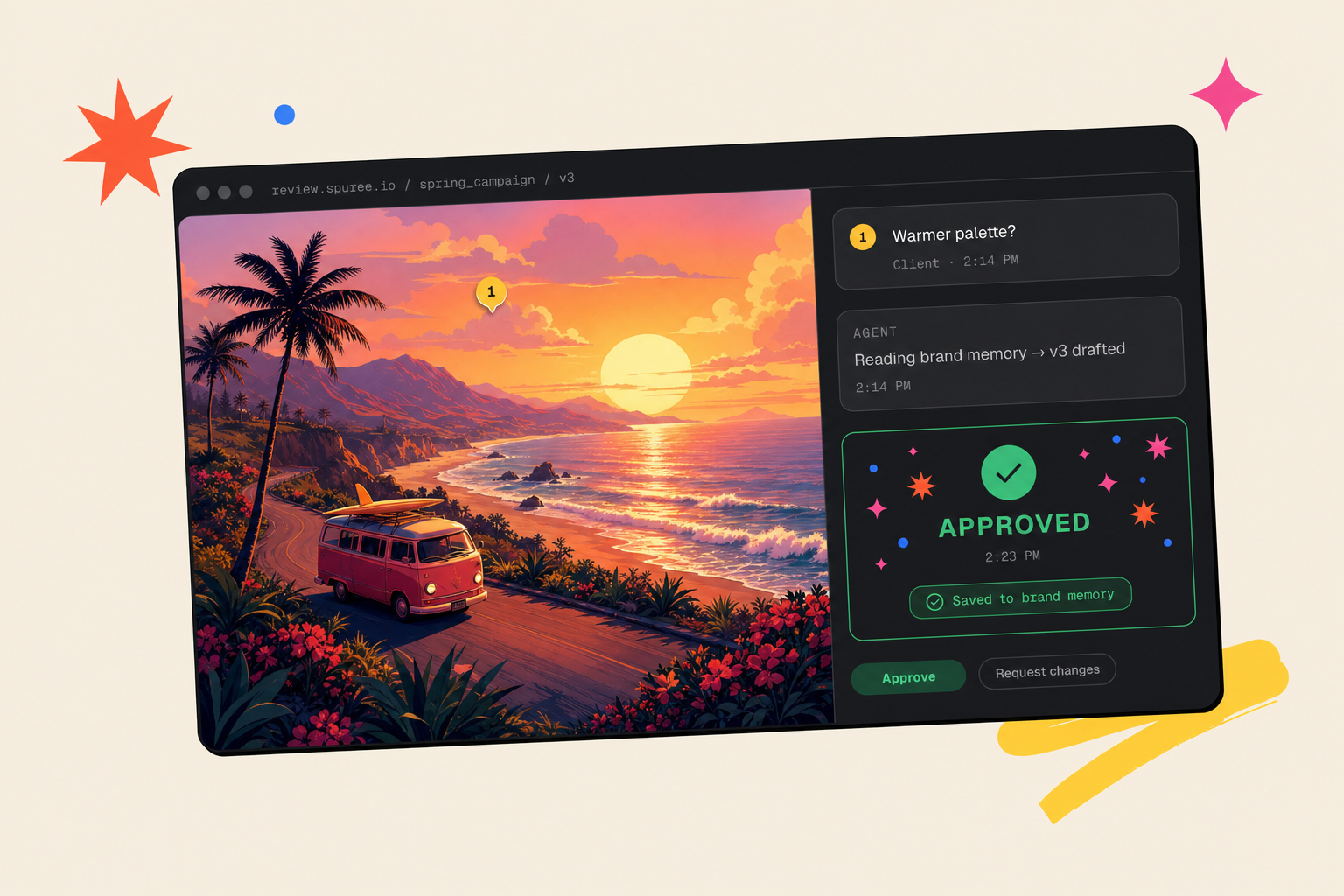
Creative Engine pulls client notes into one shared, searchable place your agent reads from Claude Code, Codex, or OpenClaw, then drafts the next version, shares it for review, and stores every approval as brand memory.
The AI workflow breaks right after generation.
Generation is the easy part. What follows is scattered between your team and your clients — and invisible to your agent.
- 1
Drafts get dumped into Slack, email, or Telegram.
- 2
Account managers turn into feedback couriers — and every round re-litigates decisions the client already signed off.
- 3
Revisions lose the context of what was actually asked.
- 4
Your agent can't read any of it — not from Claude Code, Codex, or OpenClaw.
- 5
So the next draft makes the same mistake again.
A review loop your agent can actually learn from.
Six steps, one compounding cycle. Every approval feeds the memory your agent reads, so each pass through the loop starts further ahead than the last.
- 1
Generate
Your agent drafts from project context and brand memory — right from Claude Code, Codex, or OpenClaw.
- 2
Share
One client-safe review link. Not a Slack thread, an email chain, or an attachment.
- 3
Comment
Clients and teammates pin feedback directly on the asset — nothing left in someone's memory.
- 4
Revise
The agent turns comments into the next version, with the full context of what was asked.
- 5
Approve
Every sign-off updates that client's brand and canon memory, automatically.
- 6
Reuse
The next draft starts from what's approved. The same mistake never ships twice.
Your agent connects in one command.
Creative Engine is a skill your agent installs — no SDK, no glue code. The same session that generates the work publishes it, reads the feedback, and writes the memory.
npx skills add https://github.com/CheehooLabs/SpureeSkills
Browse the skills on GitHub →- 1
Install the skill
One command teaches your agent the whole surface — projects, uploads, review links, brand memory.
- 2
Ask it to get started
Say "get started with Spuree." Your agent connects with an API key and sets up your first project itself.
- 3
Publish from the same run
Every result lands as a version behind one client-safe review link — pinned feedback and approvals flow back to the agent.
Not a chat thread. Not a git repo. A client-facing creative system.
A chat window can produce a draft, and a repo can store it. The system around them — review, sign-off, memory per client — is what your clients actually pay for.
A repo of markdown files
drafts/spring_hero_final_v3.png
feedback.md — last updated 3 weeks ago
> which version did the client approve?
stores output · …but clients don't open pull requests.
Creative Engine

Every draft goes out as one client-safe review link, every pinned comment drives a revision, every approval becomes brand and canon memory your agent reads before the next draft — and every client gets its own memory, compounding separately. The version that ships is never in question.
Built for creative work that needs approval.
Anywhere AI output meets a client sign-off, the loop applies — and the memory compounds.
Brand campaign assets
Every sign-off locks brand rules into memory before the campaign ships.
Social and ad creative
High volume, fast turnaround — and no client note repeated twice.
Product imagery revisions
Every retouch note goes straight to the agent, with full context.
“The agent drafts in seconds — then the approval crawls through Slack for a week.”
“Nothing a client signs off on should ever need saying twice.”
Show clients the work. Let every approval compound.
One loop from AI draft to client sign-off — and every approval becomes memory your agent starts from next time.